Analytics

Construction cost control software for Nepal, project by project

NepalConstruct shows each project's margin, its cost against the BOQ budget, the work still to bill and the money clients owe by age, read straight from your certified bills, receipts, store issues and wages. The web dashboard adds the order book, collection rate, retention held, output VAT and TDS, and the owner's phone shows who owes what.

  • Web and phone
  • Nepali and English
An accountant putting a ledger binder back on the office shelf at dusk, a laptop and calculator on the desk
Who uses it
Owners, accountants, PMsEach sees what their role allows
Figures from
Bills, receipts, store, wagesNothing typed again for the report
Ageing bands
0-30, 31-60, 61-90, 90+ daysOldest bills are cleared first
Where
Web and the owner's phonePhone app built for Android and iOS
01 What it does

What does cost control show?

It does the work of the month-end report your accountant pulls together from bill files, the receipt register, store books and wage sheets. The figures are worked out from those records each time you open the page, so they are as current as the entries.

Receivables

Receivables by age

Every unpaid bill is placed by age: 0-30, 31-60, 61-90 or more than 90 days. Payments you record on a contract clear its oldest bills first, so the bands show which money is late, which client owes it and on which project.

  • Payments set against the oldest bills first
  • The clients who owe the most, largest first
  • Collection rate: collected against net billed
Guide: When a running bill must be paid

Project margin

Margin per project, side by side

A project's margin is the revenue certified on its running bills less its direct cost: material issued from the store, and wages paid through payroll and approved attendance cards. All projects sit side by side with their order book and the share already billed, so a job that is losing money shows up before the final bill.

  • Direct cost = material issued + wages
  • Order book and the share already billed, per project
  • Margin for the whole firm across all projects

Cost vs budget

Cost against the BOQ budget

The BOQ is each project's budget. Certified work is set against the BOQ total, and material issued from the store against the material the BOQ needs, priced at your district rates. Material issued beyond its budget shows in red.

  • Material budget from the BOQ take-off and district rates
  • Each material green, amber or red against its budget and wastage allowance
  • Diesel issued checked against machine running hours

Tax position

VAT, TDS and retention in one place

Output VAT, the TDS your clients withheld and the retention they hold are added up from every certified bill, at the rates each bill used. Your accountant reads the firm's tax position to date without totalling bill copies by hand.

  • Output VAT from the certified bills
  • TDS withheld by clients on every project
  • Retention held by clients, for the whole firm
Guide: TDS on contract payments
02 Where it fits

Which step of the job does it close?

It is the last step. Everything recorded from the contract to the running bill ends up here as figures the owner can act on.

Win the work

  1. EstimateBOQ ready
  2. TenderBid submitted
  3. ContractContract signed

Run the site

  1. Daily site reportDPR filed
  2. Materials & storeStock reconciled

Get paid

  1. Measurement bookMB certified
  2. Running billIPC ready to certify
  3. Ledger & reportsBooks balanced
03 Compared

How is it different from a month-end Excel report?

The same owner's report, made two ways.

A month-end report the accountant builds in Excel, compared with the same figures in NepalConstruct.
TopicMonth-end Excel reportFlexible, but rebuilt by handNepalConstructWorked out from records as they are entered
How currentAs of the day it was put together, once a monthWorked out from the records each time you open it
Receivables by ageBills and receipts matched by hand, client by clientReceipts clear the oldest bills first, then 0-30 to 90+ day bands
Margin per projectStore and wage sheets copied in for each projectCertified revenue less material issued and wages
VAT, TDS, retentionAdded up from copies of each billSummed from certified bills at the rate each bill used
LayoutAny layout you like, checked by whoever built itSet dashboards and reports, the same every month
04 Step by step

Where do the figures come from?

From five records your team already keeps. Nothing is typed in again for the report.

  1. 01

    Contracts give the order book

    The value of every contract adds up to the order book. Take away what has been certified and you have the work still to bill.

  2. 02

    Running bills give revenue and tax

    Each certified running bill adds its gross amount, VAT, TDS and retention, at the rates that bill used.

  3. 03

    Receipts give collections and ageing

    Payments you record clear the oldest bills first. What is left unpaid goes into an age band, and the collection rate compares what came in with what was billed.

  4. 04

    Store issues and wages give direct cost

    Material issued from the store at its stock value, plus payroll and approved attendance cards, makes up each project's direct cost.

  5. 05

    The owner reads it on web and phone

    The dashboard and reports show it all on the web. The owner's phone shows money owed by age, the clients who owe the most and collections by Bikram Sambat month.

05 Nepal rules

Which Nepal rules do the figures follow?

Dates follow Nepal's calendar, and every tax amount is the one its bill was certified with.

A hard hat, rolled drawings and a laptop on a table in front of a building going up at sunset, with a crane and mountains behind
  • Bikram Sambat dates

    Dates show in BS on Nepali screens and AD on English ones; months and fiscal years stay BS in both, and the phone counts collections by BS month.

  • Nepal fiscal year

    The year-end close of each Nepal fiscal year carries retention still held into the new year.

  • VAT as billed

    Output VAT is the VAT on each certified bill, at the dated rate that bill used.

  • TDS withheld

    The TDS your clients deducted from each bill, totalled across all projects.

    Guide: TDS on contract payments
  • Retention held

    The retention clients hold back on every bill, totalled for the whole firm.

    Guide: How retention money works
  • Late payments

    Each bill ages from its own date, so clients who pay late stand out.

    Guide: When a running bill must be paid
06 Who uses it

Who reads these figures?

One set of figures, three people's decisions.

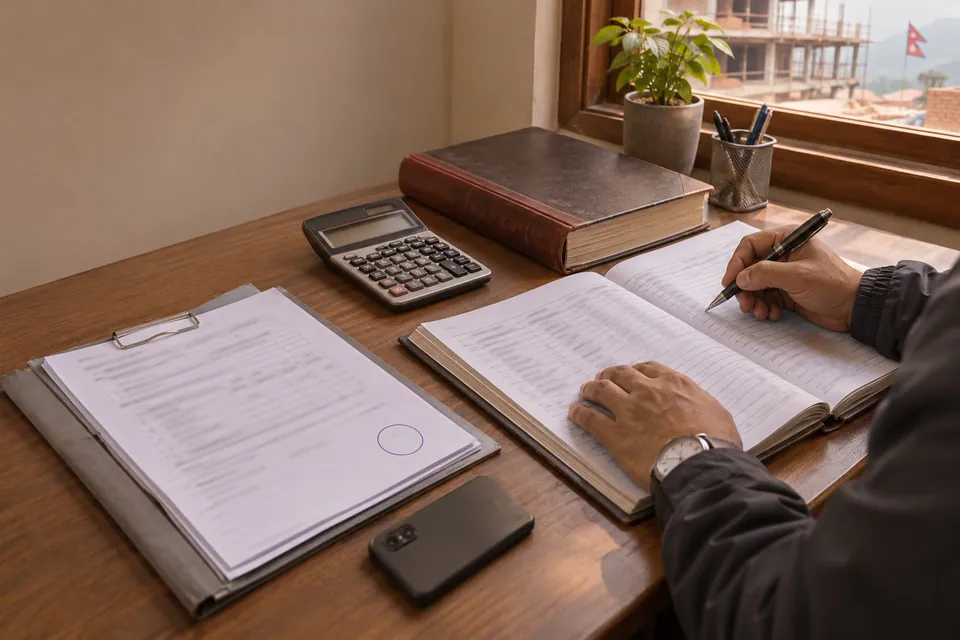
A hand checking entries in an open measurement book beside a calculator and a clipboard holding a stamped bill
  • Company owner / MD

    Checks margin per project on the web, and money owed by age and the clients who owe the most on the phone too.

    See the role page
  • Accountant

    Records receipts against bills and reads VAT, TDS and retention held without a month-end spreadsheet.

    See the role page
  • Project manager

    Watches material issued against the BOQ budget and certified work against the BOQ total on each site.

    See the role page
07 FAQ

Questions people ask

Short answers, about what is built today.

01What is construction cost control?

Construction cost control is checking, project by project, what the work has earned against what it has cost, while the job runs. NepalConstruct does it from records you already keep: certified bills give the revenue, and store issues, payroll and approved attendance cards give the direct cost, so each project shows its margin and its cost against the BOQ budget.

02Does it show my bank balance?

Not yet. NepalConstruct holds no bank account data, so it shows no bank balance and does not reconcile bank statements. Collected means the payments you record against bills, and the collection rate compares that with what you billed.

03How is the margin per project worked out?

It is the revenue certified on the project's running bills less its direct cost: material issued to it from the store, and wages paid on it through payroll and approved attendance cards. Plant and head office costs are not taken off, so read it as a gross margin.

04Can the owner see these figures on the phone?

Yes. The owner's home screen in the phone app shows the money owed by age, and tapping it opens the clients who owe the most and what came in each Bikram Sambat month. The app is built for Android and iOS, but it is not in the app stores yet.

05Does it forecast cash flow or predict losses?

No. Every figure comes from records already in the system: contracts, certified bills, receipts, store issues and wages. It shows where each project stands today, not where it might end up. Work still to bill tells you how much of the order book is left.

06How does receivables ageing decide how late a bill is?

Payments received on a contract are set against its oldest bills first. Whatever is still unpaid on each bill goes into a band by the bill's age: 0-30, 31-60, 61-90 or more than 90 days. Everything older than 30 days is shown as overdue.

07Do I still need Tally or other accounting software?

For the firm's full books, yes for now. NepalConstruct posts each running bill to its own double-entry ledger, but it does not export journals to Tally yet and holds no bank data. Our guide compares Excel, Tally and construction software side by side.

Something else to ask?

We answer against how your firm works.

Ask us